

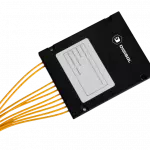


Digisol Channel SCS Splitters Tube Type SM SC APC Type 2×64
Key Feature | Description |
|---|---|
Low Insertion Loss | Minimizes signal loss for better performance |
Low Polarization Dependent Loss | Ensures stable signal quality regardless of polarization |
High Reliability | Designed for consistent and dependable operation |
High Return Loss & Good Repeatability | Reduces signal reflection and maintains consistent performance |
Wide Wavelength Range | Supports various applications across different wavelengths |
Excellent Channel-to-Channel Uniformity | Maintains consistent performance across all channels |
Excellent Environmental Stability | Performs reliably under varying environmental conditions |
Excellent Mechanical Stability | Resists physical stress and maintains integrity |
Telcordia GR-1221 and GR-1209 Compliant | Meets industry standards for quality and reliability |
Type & Configuration: Tube‑type PLC (Planar Lightwave Circuit) optical splitter with a 2×64 configuration — i.e. two input fibers, each split into 64 outputs.
Connector / Interface: Uses SC APC connectors, which are SC (“Subscriber Connector” / Square Connector) with APC (Angled Physical Contact) end‑faces, to minimize back‑reflection and maintain signal integrity.
Fiber Mode: Single‑mode (SM) fiber, suitable for long‑distance, high‑bandwidth optical communications such as FTTH / PON networks.
Tube Type Construction: The splitter is in tube type form — the fibers are likely in 900 µm loose tubes or similar protective tubing rather than in a cassette or box.
Operating Wavelength Range: It typically operates over a wide wavelength band—often 1260 nm to 1650 nm—to support multiple optical signals (for upstream/downstream, multiple services). (This is standard for many SM PLC splitters of similar type.)
Low Insertion Loss: One of the key specs is low insertion loss, meaning minimal optical power loss when signals are split.
Low Polarization Dependent Loss (PDL): Designed to keep polarization‑dependent loss low, to avoid signal distortion due to polarization changes.
High Return Loss: Thanks to APC connectors and good design, return loss is high (i.e. reflections are minimal). That helps maintain signal quality especially in upstream paths.
Good Uniformity: The splitter has excellent channel‑to‑channel uniformity, meaning all output ports have similar loss; ensures even distribution of signal strength.
Environmental Stability: Built to maintain performance over a range of temperatures, humidity, etc.; robust against environmental changes.
Mechanical Stability: Good mechanical construction — fiber routing, housing, connectors protect against vibration, bending, handling.
Standards Compliance: Meets Telcordia or GR standards—GR‑1221‑CORE and GR‑1209‑CORE for optical splitters (performance & reliability).
Applications: Used for FTTH (Fiber to the Home), PON (Passive Optical Networks), FTTx, GPON deployments etc where many outputs are required from few inputs. Good for splitting signals to many subscribers.
Reliability & Repeatability: Designed for long‑term stable performance with repeatable behavior — important for service providers to maintain predictable optical budgets.
Low Polarization Dependent Loss & Good Return Loss / Repeatability: Key optical features include low PDL, high return loss, and good repeatability among all splits. (These tie into overall system reliability / signal integrity.)
General
- Fiber Ports Quantity1
- Fiber Optic ConnectorSC
- Maximum Transfer Distance20000 m